



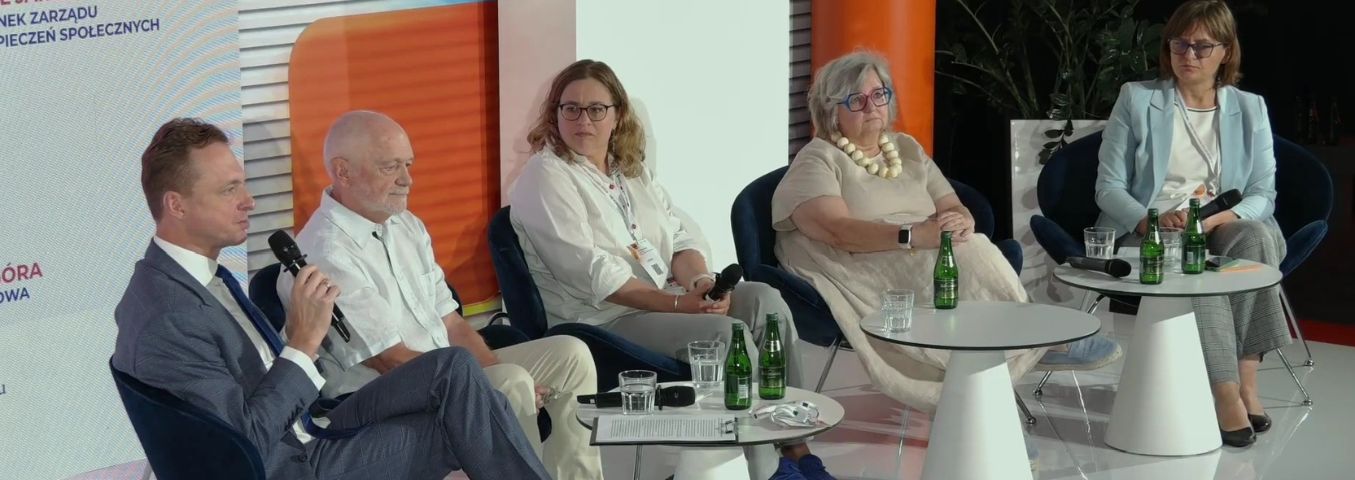
Will artificial intelligence (AI) take our jobs, or will it, on the contrary, help solve the greatest challenges facing the Polish economy? Where does the true, most pressing problem of today’s labour market lie? Experts sought to answer these questions during the “10th BKL Conference. The Labour Market: A New Era or a New Narrative?”, dedicated to the findings of the latest edition of the “Human Capital Study”.
Spis treści
Media uncertainty surrounding AI and its impact on the labour market
During the conference, Marek Szymaniak, author of the book Młócka. Reportaże o pracy przyszłości (Threshing. Reports on the Future of Work), remarked that the contemporary debate on artificial intelligence resembles a “marketplace of narratives”. In his view, neither the creators of the technology nor economists are currently able to predict what impact AI will have on the labour market over the next few years. “In truth, none of us knows what artificial intelligence will bring in a year, two, or three. Nobody has a crystal ball. All too often, we see scaremongering headlines. On the one hand, a utopian vision emerges where we will no longer need to work; on the other, an impending labour market apocalypse. Meanwhile, there is currently no hard data that would allow us to determine unequivocally the impact of this technology on employment,” he explained during his presentation.
The speaker pointed out that the narrative surrounding the threat posed by AI could become a tool for exerting pressure on staff. “Fear can be a powerful tool. It can compel us to work longer hours, take on overtime, and shoulder additional duties. We will refrain from asking for a pay rise or new perks, and we will more readily accept unfavourable changes introduced by employers,” he added.
AI in Polish companies – caution rather than revolution
Anna Szczucka and Seweryn Krupnik from the Centre for Evaluation and Analysis of Public Policies at the Jagiellonian University presented exceptionally compelling research findings. Their work highlights a considerable discrepancy between the intensity of public debate on AI and the actual steps taken by businesses. The research reveals that most employers do not yet see a significant impact of artificial intelligence on their operations and are not planning to implement AI-based solutions.
At the same time, companies are primarily focusing on employee retention and boosting engagement, while among technological challenges, they attach greater weight to process digitalisation than to rolling out artificial intelligence. “Seventy-one per cent of employers see no impact of AI on their operations and plan no initiatives in this area. The largest segment of firms (43%) comprises those considered ‘responsible towards employees’, for whom staff welfare and rising labour costs remain the priority,” attendees heard during the presentation.
A worrying trend
The conference also addressed the issue of learning and professional development among workers already in the market. Prof. Barbara Worek pointed out that the pace of change across the labour market demands continuous upskilling. “The ‘Red Queen’ effect means that when reality shifts so rapidly, we must run as fast as we can just to stay in the same place. And if we want to get somewhere else, we have to run twice as fast as that,” she observed during her presentation, “Learning to Keep Up”.
At the same time, the research points to a worrying trend: many employees feel no need for further learning, as their current working environment makes no such demands of them. “Working adults report that they do not develop their skills because their job does not require it. There is no expectation for them to do so, and they themselves believe their knowledge and abilities are entirely sufficient. We need professional inspiration to spur development,” emphasised Prof. Worek.
She also drew attention to the underutilisation of employee potential. “Thirty-seven per cent of respondents state that they frequently carry out tasks at work that are far too simple for their skill set. At the same time, the majority of people simply wish to perform work based on the knowledge they already possess,” she added.
It is not only Generation Z striving for work-life balance
Particularly intriguing conclusions also emerged from the session entitled “Are We All One Generation?”. The analyses presented show that the growing emphasis on work-life balance spans all age groups. The debate revealed that society as a whole is evolving; this shift is not down to generational succession, but rather the effect of the wider historical moment—the zeitgeist—affecting everyone alike.
“It is often said that Generation Z values work-life balance the most. Yet the value placed on leisure time has risen distinctly across all age groups. We observe no significant disparities between them,” stressed Dr Szymon Czarnik during his presentation.
The speakers also noted that many popular assumptions regarding the younger generation stem from a superficial interpretation of data and an omission of the broader social context.
AI as a “cure” for the Polish labour market’s greatest challenge?
Throughout the conference, Poland’s demographic outlook remained a central theme. One of the most fascinating discussions explored the relationship between demographic shifts and advances in artificial intelligence. The technology was framed not as a threat to jobs, but rather as an answer to the growing shortfall of workers caused by unfavourable demographic trends.
Mariusz Zielonka, Chief Economist at the Lewiatan Confederation, examined the topic in greater depth during the closing panel discussion. He pointed out that, in the face of a shrinking pool of labour, the adoption of AI is becoming an economic necessity. “The advent of artificial intelligence is, to some extent and in certain occupations, a form of salvation for the labour market. It is widely claimed that AI will take people’s jobs. In reality, it will ease our workload, enhance productivity, and enable the same volume of work to be handled by fewer staff,” he noted.
He also stressed that anxieties over mass redundancies caused by AI must be viewed against the demographic backdrop. In his view, advances in automation and the decline in the working-age population will largely offset each other, given that the labour market is already facing a dearth of workers. “Those workers simply will not be there. Demographics mean that these two trends will, in effect, cancel each other out,” he concluded.
Poland facing a major challenge
“Despite sustaining one of the highest rates of economic growth in Europe for many years, Poland is approaching the limits of its existing growth model. To preserve competitiveness and sustain progress, it is vital to transition to a new economic paradigm underpinned by innovation, knowledge, and higher productivity. This demands profound institutional reforms, a thorough reassessment of economic and scientific policy, and a long-term, strategic vision for national development,” said Prof. Jarosław Górniak.
Discussions throughout the conference demonstrated that the future of the labour market will not hinge on artificial intelligence alone. Far greater challenges remain in the form of demographic decline, labour shortages, and the ongoing need for upskilling. It is precisely within this context that AI is increasingly seen not as a threat, but as an essential tool to bolster economic growth.
Sources:
Further details about the conference can be found on the PARP website.